Mobile users won’t have to live through static screens and a one-size fits-all menus. From onboarding processes to product suggestions, generative AI mobile apps are poised to revolutionize the way users interact with their devices.
Thank you for reading this post, don't forget to subscribe!This transformation is gaining momentum rapidly: according to recent market tracking, applications based on generative AI are rapidly moving up the ranks in mobile categories, both globally and in the past three months.
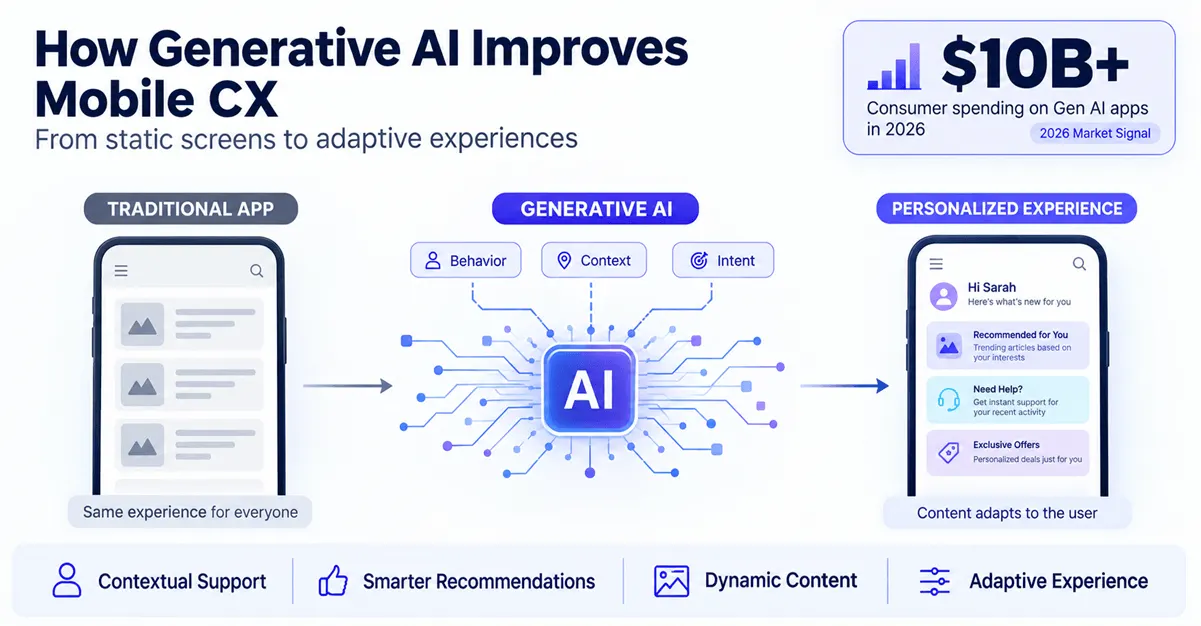
The recent industry data on gen AI application growth shows that consumer spending on the sector will hit more than $10 billion just for 2026, making gen AI widely adopted.
What are generative AI Mobile Apps?
Table Of Content
The key takeaway about AI-powered mobile apps is that they generate content live, instead of using a fixed database. Product blurbs, chat replies or even layout design can be dynamically created, depending on who is poking the screen at that time, rather than a single; one version for all visitors, regardless of their habits.
This is a substantial shift from the more traditional rule based systems. AI app development teams now create models based on the patterns of behavior and allow the app to change tone, pacing and visuals for each session. The outcome is more of an assistant that adapts around the individual user’s needs, than software.
How AI customer experience is reshaping user expectations
Users don’t want to have to repeat steps in an app, like the time they left a support ticket half-way through and didn’t remember to finish it. They don’t want to have to go back to a tone that matches their mood, or to a size they chose in a previous order.
In AI customer experience design, these details are used as indicators to take action on, and they are incorporated into all customer interactions, resulting in the app being thoughtful and dependable, even if there are a few lapses between sessions.
It’s hard to emulate this constant change using content rules. Personalized mobile apps now tailor recommendations, summaries and even when a person logs into the app to make recommendations, rather than making them based on a probable interpretation of a person’s demographic profile.
Where AI features show up inside Apps
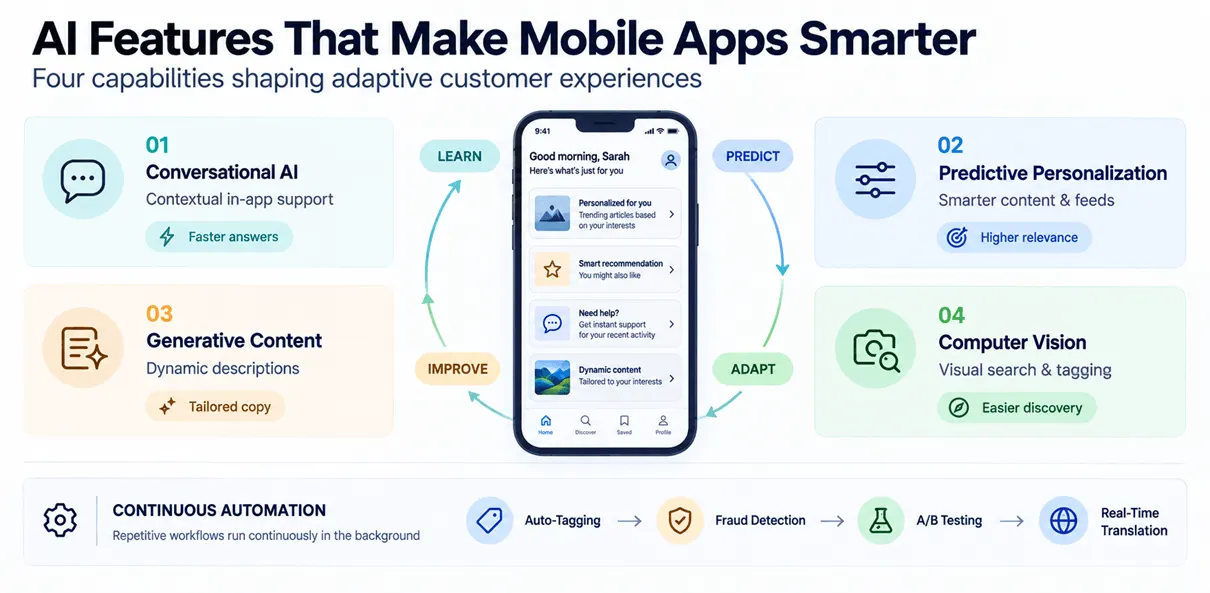
Not every AI feature carries equal weight for the end user. Some quietly improve backend efficiency while others directly touch the customer-facing experience. AI features for apps generally fall into a few practical categories that show up across retail fitness and streaming products today.
- Conversational AI for faster, contextual in-app support
- Predictive personalization for product and content feeds
- Generative content that rewrites descriptions per user
- Computer vision for visual search and photo tagging
Machine learning behind the scenes
A lot of what is “smart” is actually machine learning mobile apps that have to continuously learn and improve their predictions with every tap and purchase rather than a single training pass. That’s why this constant improvement is what makes an app truly adaptive and not just a facelifted version of the same app.
| Feature Type | Example Use Case | User-Facing Impact |
| Conversational AI | In-app support chat | Faster, contextual answers |
| Predictive Personalization | Product or content feeds | Higher relevance, less scrolling |
| Generative Content | Auto-written descriptions | Fresher, tailored copy |
| Computer Vision | Visual search, photo tagging | Easier discovery |
Mobile App automation working continuously
This enhancement in the backend allows for mobile app automation that manual teams alone wouldn’t be able to keep up with. With automated processes taking over repetitive and higher volume tasks, staff can now dedicate more time to more complex cases, where judgment and empathy are truly needed. Automatic running of common workflows is now in place
- Auto-tagging and categorizing user-generated content
- Fraud and anomaly detection during checkout
- Automated A/B testing of UI variations
- Real-time translation of chat and reviews
Future of Generative AI App Development
As for the future, Meta app design incorporates AI as a core element that guides the application’s layout, copy, and flow right from the initial wireframe and throughout its entire development. A model’s output is made flexible to fit the interface: Interfaces are designed to bend around the output from a model, allowing the screens to rearrange themselves around the output of the model based on the specific input of the specific user, at the specific time.
Generative AI app development is moving forward as it does. McKinsey’s research on AI-driven engagement provides further detail on the possibility of generative models to create dynamic, contextual messages, drawing on recent transactions and usage patterns to inform the subsequent best customer interaction. Design teams will now ship experiences that age well, because they’ve been created with this flexibility in mind.
Conclusion
The mobile apps powered by Generative AI have become commonplace. The tech-driven transformation of the customer journey is seen even at the app’s level as it adapts to personalized feeds to automated support. The companies that view AI as integral to the design, not an add-on, are the ones creating experiences that users really want to keep coming back for are the ones building experiences users will keep coming back for.