Before starting their first line of code, any founder should have a roadmap in mind when looking for a Los Angeles Game App Development Company. In today’s day and age of growing player demands and dwindling attention spans, it takes more than a good idea to launch a title that will keep players.
Thank you for reading this post, don't forget to subscribe!This guide covers all aspects of creating a mobile game using LA, from conception to post-launch assistance.
Why Los Angeles is a hub for mobile game development
Table Of Content
LA’s entertainment DNA provides a special advantage over other tech cities. Many large animation companies, sound designers, and marketing firms already operate in the city’s vicinity.
There are some benefits to using a Los Angeles Game App Development Company:
- Faster iteration through in-person playtesting
- A chance to work with Hollywood-trained art and sound talent.
- Fewer obstacles in getting hired for specialized positions, such as narrative design
- There are good networks of publishers and investors in the area.
The Local Talent Advantage
In addition to studios, LA boasts a long list of freelance artists, composers, and QA testers who frequently work on mobile projects.
This will help scale the team up or down based on the project stage.
Building a Mobile Game App: A Step-by-Step Process
Despite the different genres or engines, each successful mobile game has a similar development process.
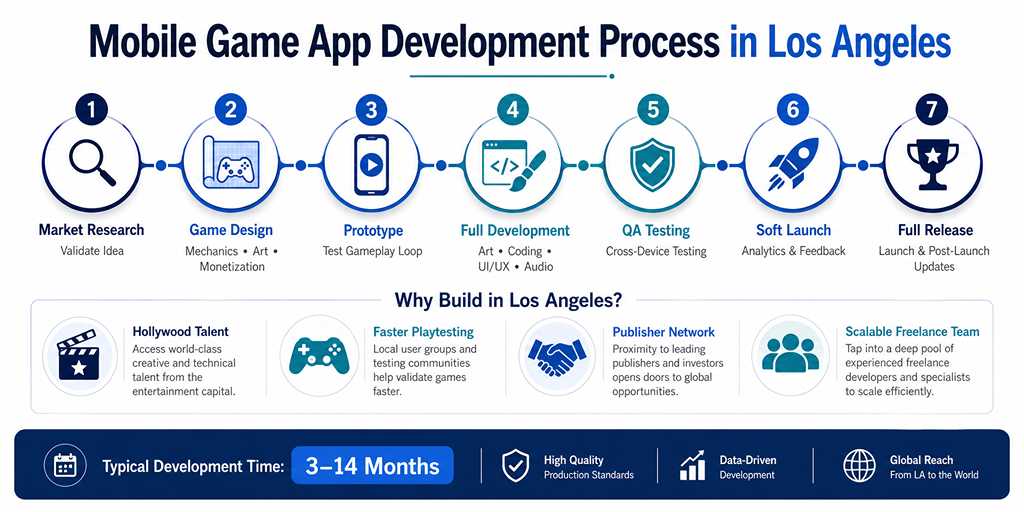
Here is the basic process that most Unity game app developers in Los Angeles follow when developing a concept from an idea to a release:
- Reviewing the competition and validating concepts
- Game design document (mechanics, monetization, art style)
- Prototyping the core gameplay loop.
- The entire production (art, code, sound, UI/UX)
- Cross-platform testing. Cross-device testing.
- Soft release, analytics review, and full release
Choosing the Right Engine and Tech Stack
The type of engine used will influence the build time, performance, and even the number of developers available.
While casual and mid-core mobile games still do the vast majority of their business in Unity, studios creating games with heavy graphics will choose Unreal Engine.
Mobile Game App Development Cost in Los Angeles
One of the initial questions founders ask is always about budget, and typically, expectations fall short of reality.
Mobile game app development costs in LA tend to be higher than in other secondary markets due to local salary norms. Mobile monetization is becoming more concentrated, and every download must do more to prove its purchase value, impacting studios’ production budgets, according to a widely cited industry report: Sensor Tower’s State of Gaming 2026.
Casual games with original art and a stable backend typically cost $50,000 to $150,000, and mid-core titles that include progression systems can be upwards of $300,000.
Table for Cost Breakdown
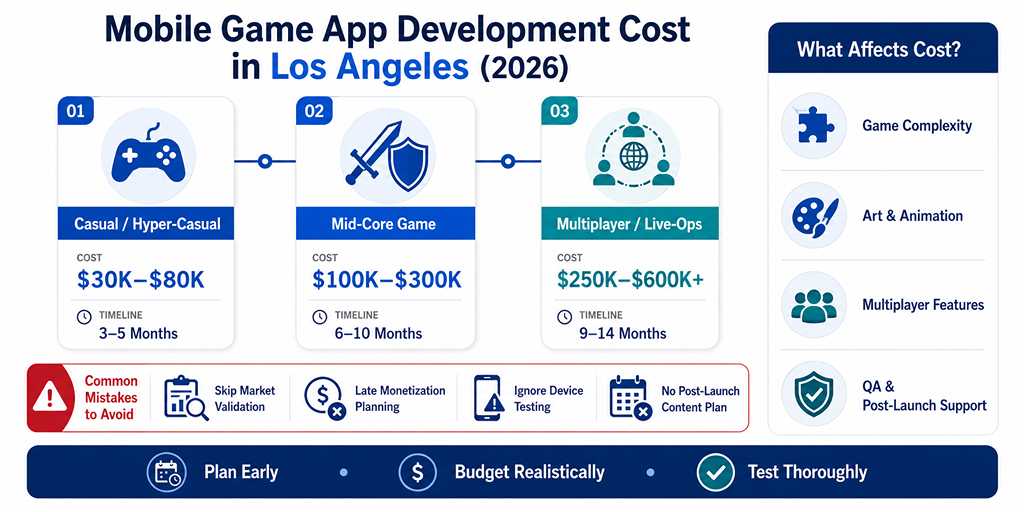
| Game Type | Estimated Cost Range | Typical Timeline |
| Simple casual/hyper-casual | $30,000 – $80,000 | 3–5 months |
| Mid-core with progression | $100,000 – $300,000 | 6–10 months |
| Multiplayer/live-ops title | $250,000 – $600,000+ | 9–14 months |
What Drives the Mobile Game App Development Timeline
The duration of timelines depends on the scope, but art and animation always seem to take the most time.
A realistic mobile game app development timeline needs to include a buffer for QA, as bugs identified late cost much more to fix.
Mistakes to Avoid When Building a Mobile Game App
Even the best-funded projects are doomed if the teams do not take the necessary steps at the beginning.
A study on the industry’s failure to produce successful games has revealed that studios with less-than-sterling reputations tend to pull games off the market once they fail to monetize well, even if they are well received (Game Developer’s study on why mobile gaming ventures fail).
Common mistakes to avoid when building a mobile game app include:
- Not performing market validation before development.
- Monetization as an afterthought.
- Ignoring QA for device variety.
- Avoiding a post-launch content plan
Comparing Costs Across Other U.S. Markets
But LA is by no means the only city that has a thriving game development community, and that’s why it’s important to compare cities to help founders get a sense of where their budget will fit in.
Chicago game app developers, teams in Miami game app developers, and Austin game app developers are slightly less expensive on the hourly rate, whereas New York Game app development services and San Francisco game app development services may offer premiums much like LA.
Choosing the right development partner
Not all studios make games; some agencies divide their focus between games and utility apps, which can spread the quality.
Meta App Designs specializes in visual and UX expertise, and in this genre, first impressions are crucial to establish trust.
Beyond Gaming: Diversified App Expertise
Other development shops in LA also offer gaming app development services, such as restaurant mobile app development, indicating greater technical flexibility.
Such cross-industry experience also benefits them by providing a more robust backend architecture and greater payment reliability.
FAQs
Conclusion
Creating a mobile game in LA calls for best-in-class creativity, along with planning for cost, time, and partners. Only studios that validate early, have a realistic budget, and do what is necessary after the launch will be successful.