Every upcoming mobile generation silently resets the apps capabilities, and 5G mobile app development is the reset reshaping the current digital landscape. It has already redefined surgery rooms, factories, and stadiums – not just download speeds. At Meta App Designs, this network upgrade is determining how mobile apps would be designed from day one.
Thank you for reading this post, don't forget to subscribe!A Race That Keeps Gaining ‘G’
Table Of Content
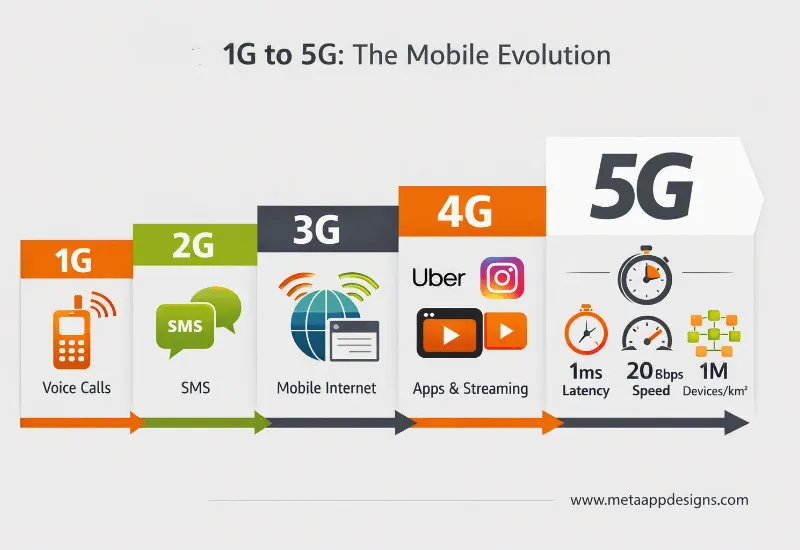
The “G” simply stands for generation, but every generation has represented a substantial progress in what mobile networks are capable of supporting. Mobile networks continue to reinvent themselves roughly every decade.
NTT switched on the first 1G network in Tokyo back in 1979 – voice-only, no data. GSM’s 2G brought text messaging in the early 1990s. NTT DoCoMo then launched 3G in 2001, opening the path to mobile internet. 4G LTE went live in Oslo and Stockholm in 2009, introducing streaming and app-based era a new reality.
Samsung and Verizon then launched the Galaxy S10 in market in 2019 as one of the first commercial 5G phones. Six years on, 5G applications are already dominating factories and operating rooms, and serious 6G research is well underway.
How 5G Actually Works?
Have a look at this simple mental model: Mobile device → 5G radio network → 5G core/cloud → internet or nearby edge server → application.
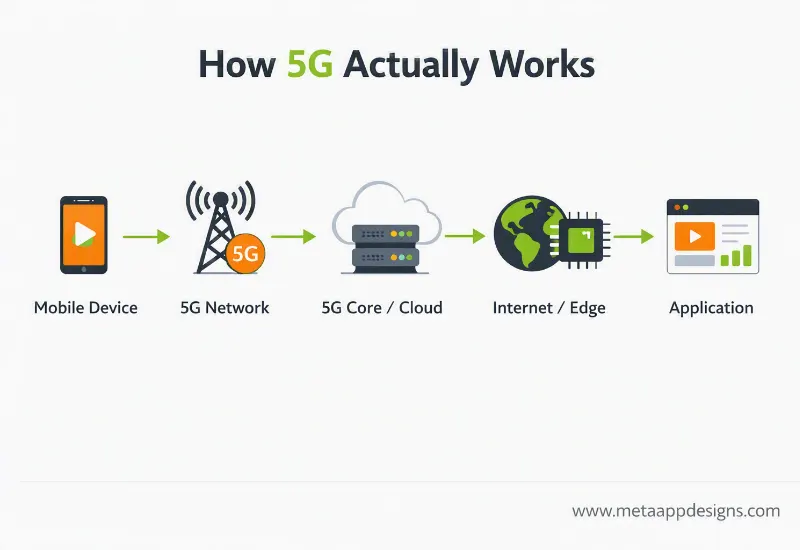
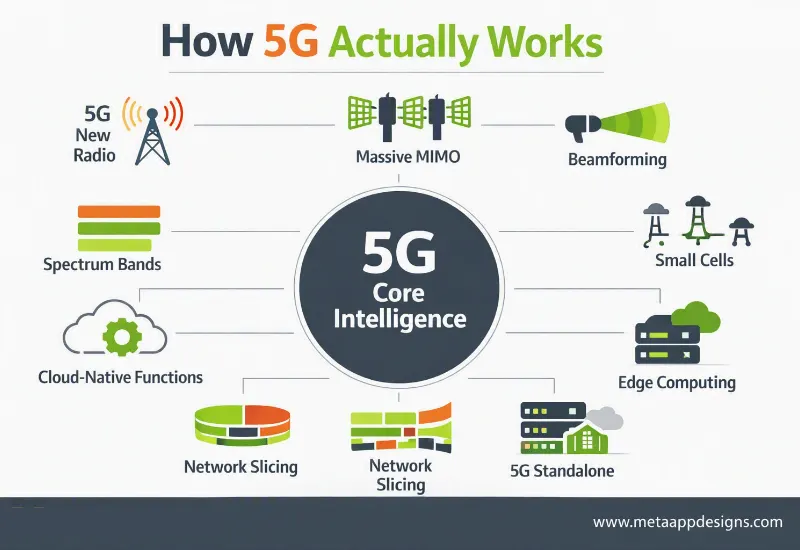
After knowing its operational framework, it’s also important to understand the technical stack which drives this structure. Here we know that, 5G comes down to three things from technical perspective – mmWave and Sub-6GHz bands provide the raw speed.
Network slicing creates dedicated lanes for gaming, healthcare, or IoT, so one doesn’t compete with another. And edge computing processes data near you instead of in a distant cloud – reducing lag to milliseconds.
What Changes Under the Hood?
The transition from 4G to 5G isn’t just marketing math – the stats prove why low-latency mobile apps and real-time mobile apps are finally practical, not theoretical:
| Metric | 4G LTE | 5G |
| Peak speed | ~100 Mbps | Up to 10–20 Gbps |
| Latency | 30–50 ms | As low as 1 ms |
| Device density / sq km | ~100,000 | ~1,000,000 |
This density gain is what makes IoT and 5G such a natural and effective combination. Connected sensors, wearables, and machinery can now share a network without choking it, while edge computing keeps processing in such a close proximity to the user that response times now remain imperceptible.
5G’s Real-World Impact
The impact of 5G is now visibly tangible across different industries, but its presence still stays uneven geographically. A Fraunhofer IPT and Ericsson case study on precision manufacturing confirm that 5G-enabled real-time process control could save one factory approximately €27 million annually, with industry-wide potential approaching €360 million.
Hospitals are adopting XR-assisted surgery over private 5G, while stadiums are exploring backpack-free VR. Yet, by the end of 2025, 5G is available to just over half the global population – more than 80% in developed part of the world but under 5% in developing countries, according to Statista’s analysis of ITU coverage data.
The 5G network infrastructure, supported by technologies provide the speed, capacity, and low latency required to support low-latency mobile apps, real-time mobile apps, and IoT and 5G apps across manufacturing, healthcare, automotive, and retail.
For next-generation mobile apps, however, 5G should optimize the experience without assuming universal coverage.
5G When Paired With AI Becomes The Real Power
Consider 5G as the highway and AI shall be the driver. This combination allows AI models to run partly on-device and partly in the cloud. The outcome is hyper-personalization where apps become capable of adapting UI based on user behavior patterns
Therefore, the most interesting future may not be 5G alone but 5G combined with AI and edge computing. An AI-enabled application can analyse images, speech, sensor readings or user behavior, while edge infrastructure can minimize the distance data needs to travel.
Imagine a warehouse inspector using smart glasses to count inventory. With 5G Standalone, AR information can respond almost instantly to movement, while edge computing handles demanding processing nearby. The result is a more responsive experience, where the network actively supports the app instead of simply carrying its data.
Where Is It Heading: 6G and Beyond
The trajectory keeps progressing: 5G unlocked real-time, and 6G, expected 2030, will be AI-native. Imagine holographic calls, brain-computer interfaces, and digital twins fully functional on your mobile phones.
In February 2026, Nvidia joined BT Group, Deutsche Telekom, SoftBank, and T-Mobile in committing to build 6G on AI-native infrastructure from the ground up, rather than treating AI as an add-on the way 5G largely does.
Meanwhile, the EU AI Act reached full application for most high-risk obligations in August 2026, pushing developers toward privacy-conscious, on-device architecture as the default rather than an afterthought. Both signals point the same direction: intelligence and regulation are converging on the network layer itself.
Meta App Designs: The Execution Layer
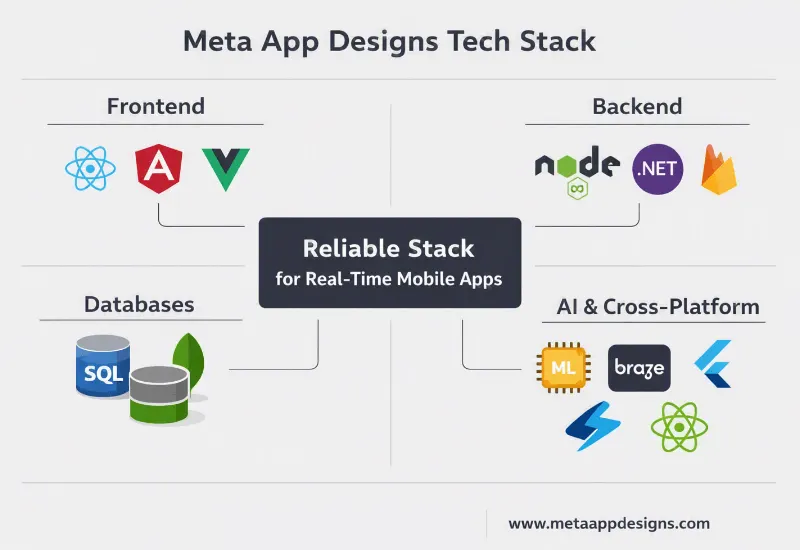
This is exactly where Meta App Designs 5G app development becomes highly relevant. Through a structured discovery-to-deployment process, and a stack including React, Angular, Node.js, Firebase, and MongoDB, Meta App Designs mobile development means deciding early where processing happens – on-device, at the edge, or in the cloud – rather than retrofitting it post-launch.
This approach offers authentic 5G technology benefits into fintech, healthcare, eCommerce, and on-demand apps, where speed and dependability now define user trust as much as convenience.
The Challenges Nobody Talks About
5G has created exciting opportunities, but developers still need to build apps keeping in context its limitations:
- Coverage gaps suggest users may want to switch between 5G and 4G, so apps must degrade gracefully without compromising the experience.
- Device fragmentation adds another layer, specifically on Android, where varying hardware and network capabilities demand adaptive design and testing.
- Security also becomes more significant as real-time data, cloud services, edge computing and connected devices expand the attack surface, demanding strong encryption and privacy-first architecture.
These challenges prove why successful 5G applications rely on thoughtful planning, resilient architecture and user-focused design – not simply faster connectivity.
FAQs
Gateway To Next Generations
5G mobile app development is not necessarily just a faster version of previous ‘Gs’; this particular ‘G’ is a multifaceted technological breakthrough that has laid the foundation for the next generation of mobile apps to reach new heights.
It’s essential to understand where 5G has covered the gaps and where the gaps still await to help businesses build reliable and sustainable apps. Meta App Designs is well-aligned with this approach to building apps for the future.