AI-powered personalization has marched passed beyond recommendation lists. In current digital landscape, it has established new standards for mobile experiences. It is no longer just about recommending what users should receive; instead, it is about delivering apps that adapt to their needs in real time.
Thank you for reading this post, don't forget to subscribe!From how a work dashboard is designed to how a fitness app schedules workouts, AI is redefining the entire user experience.
For Meta App Designs, this evolution shows the next frontier of mobile app solutions – building apps that are not only suggestive but also intelligently responsive to every user.
Understanding The True Implication Of “Beyond Recommendations”
Table Of Content
Now, imagine yourself in a world when personalization meant to follow recommendations. Then fast-forward to present world, where personalization powered by AI, has evolved beyond recommendations.
Understand this before-and-after situation through a simple scenario: previously, you entered a store where a salesperson recommended products to you. Now, you enter a store transformed by AI-powered personalization, which smartly rearranges itself around your needs.
It uses machine learning personalization to analyze plus evaluate behavior, context, and intent, then changes the app itself. As a result, the entire approach has changed – now the goal isn’t just suggesting better recommendations; it’s about creating better experiences.
The Technology Driving AI-Powered Personalization
Behind every personalized mobile experience is an integrated version of smart technologies performing collectively in real time. Instead of depending on a single AI model, advanced apps deploy variety of technologies to understand its users, anticipate their actual needs, and consistently improve their experience.
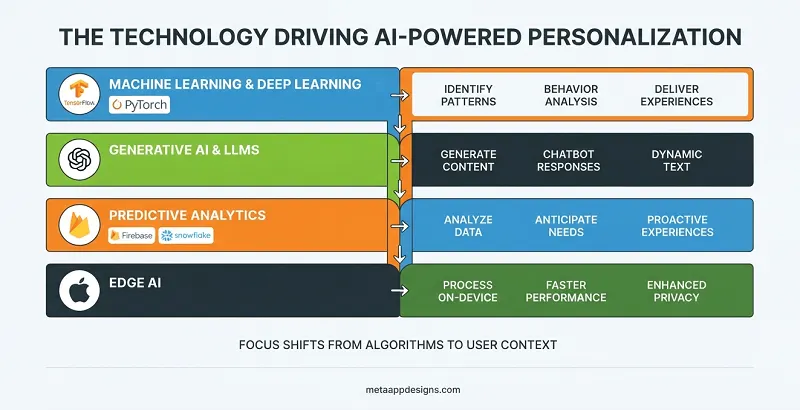
Machine Learning & Deep Learning
Tools like TensorFlow and PyTorch spot consistent behaviors in how users tap, scroll, pause, and interact with an app. For instance, streaming platforms learn viewing patterns to personalize content over time.
Generative AI & LLMs
AI Models like GPT-4 produce dynamic text, emails, chatbot responses, or teaching tips customized to each user’s tone and preferences.
Predictive Analytics
Platforms like Firebase and Snowflake analyze user data to predict what someone would possibly need or would do next, creating proactive app experiences.
Edge AI
Technologies like Apple’s Neural Engine carry out AI tasks directly on the device, enabling apps to adapt quickly while ensuring user-sensitive-data stays private.
This is the reason why AI app development in 2026 has shifted its focus From algorithms to deeper understanding of user context.
Where You Are Already Witnessing It: Work + Daily Life
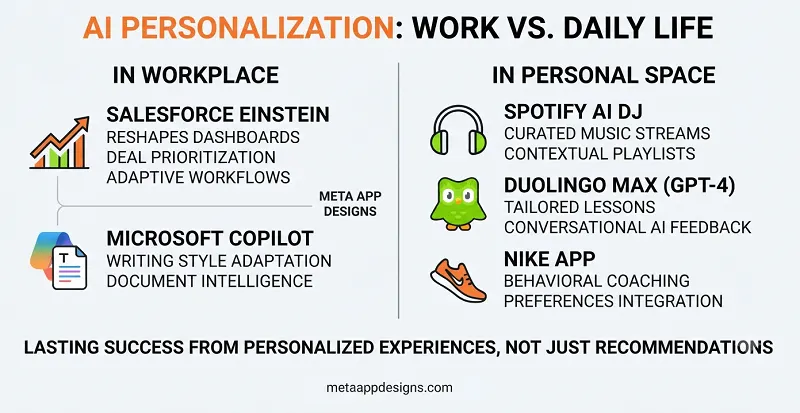
Personalization is no more just about shopping apps – It’s now part of your workplace and personal space.
In Workplace
LLMs such as Microsoft Copilot is trained to learn plus adapt to your writing style and draft proposals in your personalized tone. Similarly, Salesforce Einstein has the capability to reshape the CRM dashboards based on the deals each sales representative is most likely to close.
The interfaces are being built to adapt to users, not the other way around. This is customer experience when AI applied internally.
For businesses, Meta App Designs AI app development can offer the same services – developing custom field apps where KPIs, shortcuts, and workflows adapt according to each employee’s role and performance.
In Personal Space
Spotify’s AI DJ doesn’t just limit itself to song suggestions. It works at a very personal level with its listeners, by matching music to their mood and weather, and creating playlists in real time.
Duolingo Max, similarly, uses GPT-4 not to just list but explain grammatical errors like a tutor who personally knows its student. Nike’s app also follows the same personalized experience philosophy by adjusting its training plans based on users’ sleep, activity, and recovery data.
These are smart mobile apps and globally acknowledged success stories that followed a proactive approach and adhered to AI-Powered Personalization years before. Exactly at this point lies the core difference between: who wins and who loses: who just recommends and who truly personalizes.
Present Digital Surge As the Tipping Point
There are 3 forces which are pushing AI-powered personalization mainstream this year:
Force 1: Market Demand – The global AI personalization market is expected to cross USD 21.5B in 2034, growing over 24% YoY. Users now expect apps to recognize them instantly, particularly on mobile where 90% of digital time is spent.
Force 2: Technology Maturity: Frameworks like React and Firebase – the same stack Meta App Designs uses – now support real-time adaptive UIs at scale. It’s no longer experimental, in fact, very adaptive and practical options.
Force 3: Regulation & Trust: The EU AI Act and India’s DPDP Act are pushing for transparency. Users desire personalization but without privacy trade-offs. This favors businesses with ethical governance and on-device AI – exactly where Meta App Designs positions itself with data privacy and responsible AI practices.
Here is an example to reinforce the impact of this collective force: JPMorgan rolled out an internal AI assistant that personalizes research reports and meeting prep for each banker, reducing prep time by 30%. It’s not recommending documents – It’s rebuilding the workflow.
How Meta App Designs Implements AI Personalization into the Real World
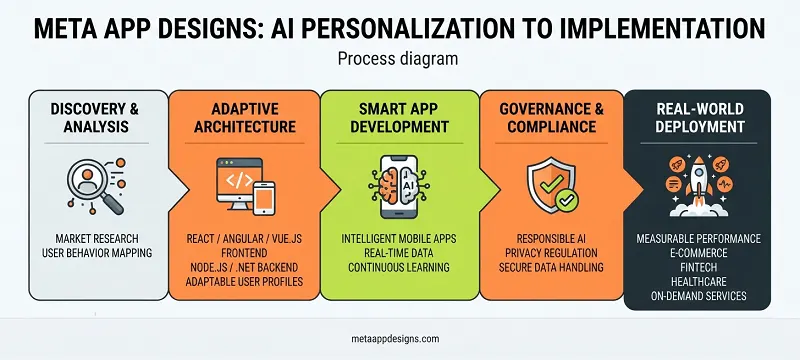
Meta App Designs doesn’t blindly chase off-the-shelf solutions. rather, its goal is to create the complete lifecycle of personalized mobile apps that guarantee measurable performance.
Each venture starts with thorough market analysis and user behavior mapping, laying the ground for AI-powered personalization. Instead of developing generic apps, the firm begins with MVPs offering adaptive onboarding for startups and scalable enterprise solutions delivering dynamic dashboards and predictive capabilities.
Its advance technology stack – including React, Angular, Vue.js, Node.js, .NET, Firebase, MongoDB, and MySQL – supports responsive frontends, real-time backends, and adaptable user profiles.
Through Meta App Designs AI app development, the company also takes care of privacy and responsible AI to comply with changing regulation policies.
As a result, Meta App Designs mobile app solutions succeed in creating smart apps that continuously learn, adapt, and improve user experiences across multiple industries, such as: eCommerce, fintech, healthcare, and on-demand services.
Conclusion
AI-powered personalization is no more limited to a feature status. It has evolved into the tech-ecosystem which serves as the foundation for modern apps.
As LLMs march ahead in terms of sophistication, they are a driving force behind the change in how we work, shop, learn, and live – one adaptive experience at a time. For businesses, the winners will be those who build apps that feel personal.
With its emphasis on custom, ethical, and efficiency-driven development, Meta App Designs is guiding brands how to turn expectations into successful + sustainable reality.