![Cost to Build a Crypto Exchange App Like BitOasis 2026 [Guide] - Meta App Designs](https://www.metaappdesigns.com/blog/wp-content/uploads/2026/05/Cost-to-Build-a-Crypto-Exchange-App-Like-BitOasis-2026-Guide-Meta-App-Designs.jpg)
In the current digitalized world, developing a crypto exchange app is no longer limited to a fintech experimentation – it has evolved into a high-demand digital infrastructure investment. There is a rise in crypto adoption throughout the Middle East, particularly in the UAE.
Thank you for reading this post, don't forget to subscribe!The trend has turned platforms like BitOasis into credible benchmarks for both startups and enterprises. As regulated crypto operations continue to expand, firms are eagerly exploring mobile app design and development services to capture their share of this crypto space, with development costs ranging from AED 91,800 to AED 917,500+.
The recent surge is validated by research findings, which reveal that MENA crypto transaction activity has surpassed the billion-dollar mark in annual volume, driven by regulated adoption in UAE markets.
What Is a Crypto Exchange App: Is It Like BitOasis?
Table Of Content
A crypto exchange app is a digital platform that enables users to purchase, sell, hold, and execute cryptocurrency transactions using assets such as Bitcoin or Ethereum. A centralized exchange like BitOasis serves as an intermediary that oversees liquidity, security, and cryptocurrency trading.
At its core, the system comprises wallets, trading engines, KYC verification, fiat payment integration, and real-time pricing charts. The target market comprises retail investors, fintech startups, banks, and digital-first enterprises interested in participating in the digital asset economy.
More importantly, it connects traditional finance with decentralized blockchain ecosystems.
Why Businesses Are Investing in Crypto Exchange Apps in 2026?
The desire to invest in crypto platforms is increasing due to three main factors:
1. To achieve transparency in currency regulation.
2. To institutionalize the digital economy.
3. To accelerate cross-border payment efficiency.
For instance, the UAE’s regulated crypto ecosystem has helped push the annual regional digital asset volumes beyond $50B.
Stablecoins alone have processed trillions in global trade, practically proving their financial viability rather than mere speculation. This shift in dynamics has prompted businesses to seek fintech mobile app development services as a strategic move to enter Web3 finance.
Despite the increase in adoption, the risks involved can’t be overlooked. The complexity of this space is evident in volatile markets, cyber threats, and ongoing regulatory changes.
Businesses entering it without a strong technical background usually collapse within the initial phase of growth.
Role of Mobile App Design and Development Services in Building a Crypto Exchange App
First of all, it is important to understand that designing a crypto exchange is not a single-step task; it is a multi-layered workflow development process.
It involves full-stack engineering, security architecture, and financial compliance systems, which makes the role of mobile app design and development services more significant than ever. Below are some of these prominent roles briefly explained:
User Onboarding System
Manages registration, verification of identity, and KYC checks. This is crucial for regulatory compliance.
Trading Engine
It is the core system that bridges the buying and selling of orders in real time while controlling execution delays.
Wallet Infrastructure
This comprises hot wallets for transactions and cold wallets for safe asset storage.
KYC/AML Compliance Layer
Protects against fraud and enables legal onboarding of users deploying tools like Onfido or Sumsub.
Fiat Integration
Enables users to deposit or withdraw local currencies through banking systems or payment gateways.
Security Architecture
Deploys encryption, multi-signature wallets, and HSMs to ensure the security of user funds.
Admin Dashboard
This ensures system monitoring, transaction control, and compliance tracking.
Similarly, a strong Android mobile app development company usually focuses on cross-platform development using frameworks like Flutter or React Native to enable efficient deployment across devices.
On similar grounds, Crypto Exchange App Tech Stack Framework offers the following technologies across different development layers:
| Sr. No. | Development Layer | Recommended Technologies | Primary Function |
|---|---|---|---|
| 01 | Frontend | React Native / Flutter | Cross-platform mobile interface for Android & iOS |
| 02 | Backend | Node.js / Go | Trading engine, APIs, transactions & core logic |
| 03 | Database | PostgreSQL / Redis | Secure data storage, caching & real-time processing |
| 04 | Cloud Hosting | AWS / Azure | Infrastructure scalability, uptime & deployment |
| 05 | Blockchain | Ethereum / Polygon | Smart contracts, token transfers & transaction validation |
Other industries, including healthcare or e-commerce, also adopt the same modular architecture models, much like how to build an E-Commerce App Like Amazon, or how healthcare mobile app development cost frameworks are designed for scale and compliance.
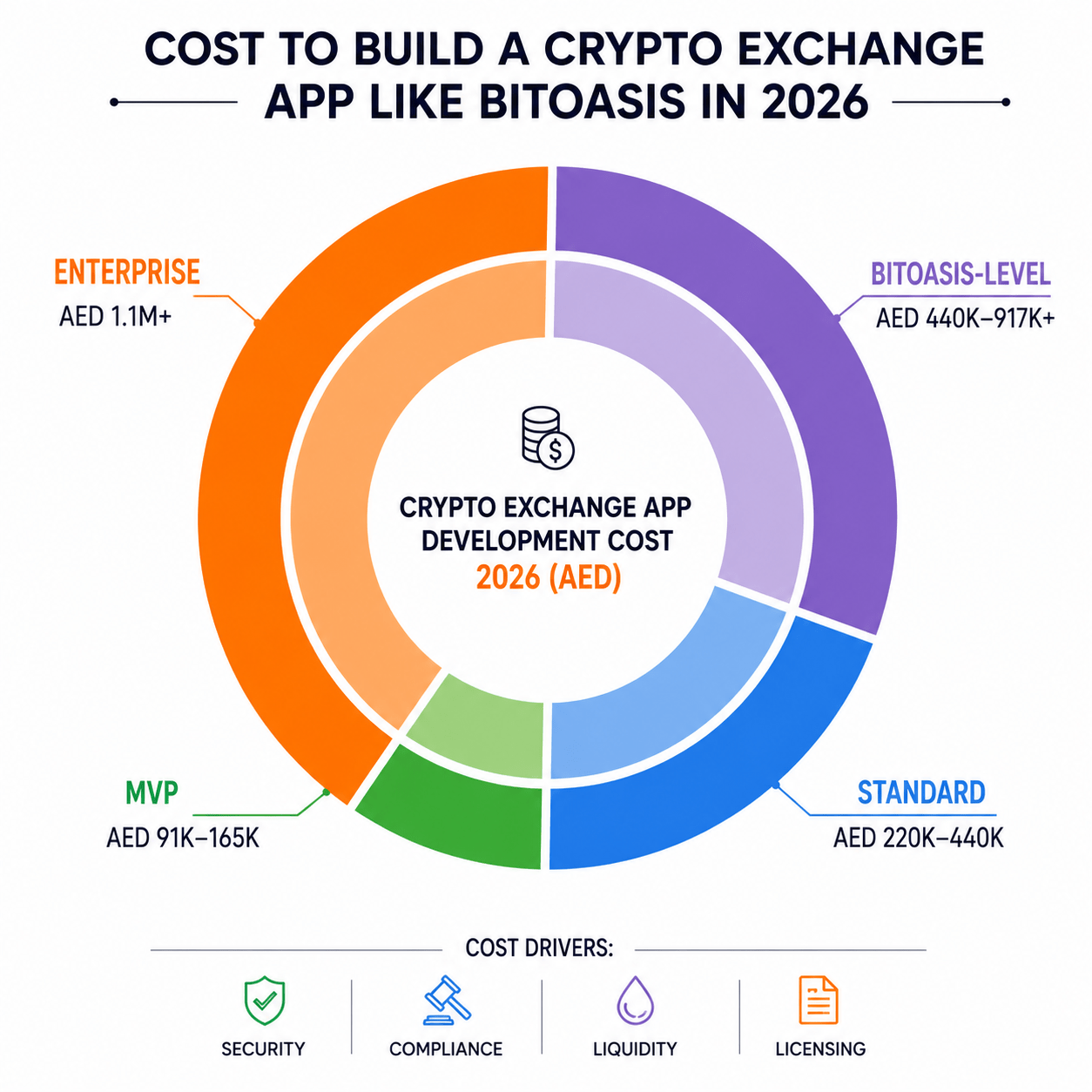
Cost to Build a Crypto Exchange App Like BitOasis in 2026
The cost is dependent mainly on architecture complexity and compliance scope:
- MVP Exchange: AED 91,800 – 164,900
- Standard Exchange: AED 220,200 – 440,400
- BitOasis-Level Platform: AED 440,400 – 917,500+
- Enterprise Exchange: AED 1.1M+
This difference in costs originates from security implementation, liquidity integration, and regulatory licensing. Compliance alone would add around AED 55,000 to 220,000 due to legal audits and jurisdictional requirements.
Compared to other projects, like how much does it cost to build a taxi app or how much does it cost to build a web app, and even mobile game development costs in 2026, crypto exchanges are practically more complex and costly because of the financial risks involved and real-time asset management responsibilities.
Step-by-Step Development Process and Cost Breakdown
The development lifecycle generally follows this structure:
- Planning & Research: Market strategy and compliance mapping [AED 18K-55K]
- UI/UX Design: Interface design and utility flows [AED 25K-91K]
- Backend Development: Trading engine and APIs [AED 146K-550K]
- Frontend Development: Mobile and web interfaces [AED 73K-183K]
- Security & Compliance: Encryption, audits, KYC [AED 55K-183K]
- Testing & QA: System validation and bug fixing [AED 36K-128K]
- Deployment: Hosting and launch setup [AED 11K-55K]
Total cost aligns with the final budget range of AED 91,800 to AED 917,500+.
CRYPTO EXCHANGE DEVELOPMENT LIFECYCLE & COST BREAKDOWN [2026]
1. PLANNING
AED 18K-55K
2. UI/UX DESIGN
AED 25K-91K
3. BACKEND DEVELOPMENT
AED 146K-550K
4. FRONTEND DEVELOPMENT│
AED 73K-183K
5. SECURITY & COMPLIANCE
AED 55K-183K
6. TESTING & QA
AED 36K-128K
7. DEPLOYMENT
AED 11K-55K
TOTAL ESTIMATED COST
AED 91,800 – AED 917,500+
Smart Ways to Reduce Crypto Exchange App Development Cost
One of the most effective strategies is to begin with an MVP rather than a full-scale exchange project. This allows businesses to test demand before further scaling the infrastructure.
Another smart strategy could be “white-label exchange customization,” which considerably reduces initial build time. Cross-platform development with Flutter also reduces costs compared to separate native builds.
Similar to calculating how much does it cost to build a web app, complexity and feature depth are the biggest cost inducers. Relying on simplified features in the initial phases usually yields better ROI for fintech launches.
How to Build a Better Crypto Exchange Than Existing Platforms?
Since the increased digitalization, the market has become highly competitive. Therefore, to build a better Crypto Exchange, businesses are required to focus on innovation rather than imitation.
In 2026, well-performing crypto exchange platforms are moving beyond basic trading by offering AI-powered insights, Arabic-first user experiences for the MENA market, Sharia-compliant investing options, beginner-friendly micro-investments, and hybrid DeFi-CeFi ecosystems.
The market is transitioning from pure trading platforms to financial ecosystems. This is where differentiation becomes pivotal.
Meta App Design Might Be The Solution You Are Looking For
Crypto exchanges are no longer standard apps – they have evolved into financial infrastructure systems. It implies that security, compliance, and scalability have become essential components of it.
Mobile app design and development services like Meta App Designs have the experience to approach these systems with proper planning, architecture-first thinking, and sustainable scalability in mind. Instead of rushing builds, the focus remains on secure foundations, regulatory alignment, and performance optimization.
This is particularly significant for fintech-grade platforms where even minor architectural flaws can lead to major, costly risks.
Conclusion
Building a crypto exchange app like BitOasis in 2026 is a high-investment, high-reward opportunity. The cost ranges from AED 91,800 to over AED 1.1M, depending on size and compliance. However, success is not just about saving cost – it’s about architecture, regulation, and execution quality.
Businesses that invest in the right mobile app design and development services and plan strategically will have a clear advantage in the evolving digital finance ecosystem. Build lean, stay compliant, and scale intelligently with the right technical partner, like Meta App Designs, guiding the foundation.