Despite all the native app buzz, more companies are recognizing the value of the PWA and actively pursuing the development of a progressive web app development to solve real business challenges, such as slow page load times, high acquisition costs and app store friction.
Thank you for reading this post, don't forget to subscribe!A good PWA works like a normal app, but rests in the browser, so that users have immediate access, without downloading or updating. When businesses are considering where to spend their development budget in 2026, understanding why PWAs remain relevant is no longer optional.
The Real Value of Progressive Web Apps for Businesses Today
Table Of Content
Progressive web apps combine the reach of the open web with the performance users expect from installed software. That combination is why progressive web apps now power everything from retail storefronts to internal business tools, giving companies a single codebase that works across devices instead of separate iOS and Android builds. Before choosing this route, it helps to understand what actually separates a PWA from a traditional native app under the hood.
What Makes PWAs Different from Native Apps
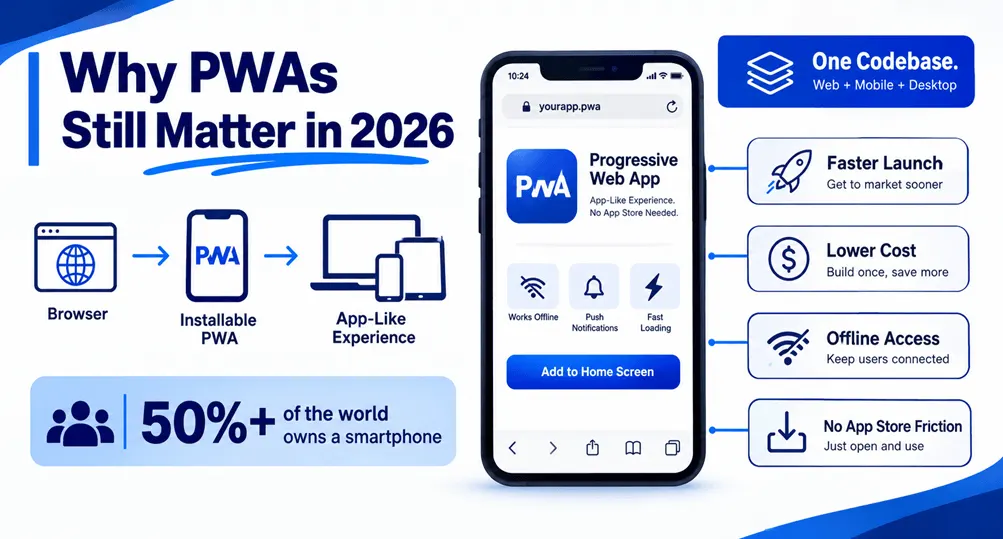
A PWA is basically a website with service workers, caching logic and a manifest file that can be installed on the home screen and still function offline. There is no app store review process for app releases as with native apps, resulting in faster releases. That’s why more and more web app development teams are suggesting PWA for startups that must get their product to market quickly.
The sacrifice is that some device-specific APIs are unavailable, though in the last 2 years, that’s been reduced significantly in browser support, so today, for most mainstream needs, PWA is a viable choice.
Core Benefits Driving PWA Adoption
Businesses don’t adopt new technology without a clear return, and PWAs deliver on several fronts simultaneously speed, cost, and reach. Companies offering PWA development services claim quicker deployment times when compared with parallel native builds, because they work with a single code base.
The efficiency is even more important in an era of global smartphone growth: in fact, more than half of the world’s population today owns a smartphone, and the widespread access to these devices is directly shaping demand for speedy and light web experiences such as PWAs, according to a report cited by Market.us from the GSMA, a global communications industry body.
The measurable PWA benefits are not limited to the actual development speed but are present in users’ daily actions as well:
- Faster load times, even on unstable mobile networks
- Lower bounce rates due to app-like navigation
- No mandatory app store approval delays
- Reduced maintenance costs across platforms
- Built-in offline access and push notifications
Mobile App vs PWA: Decide What’s the Best Fit
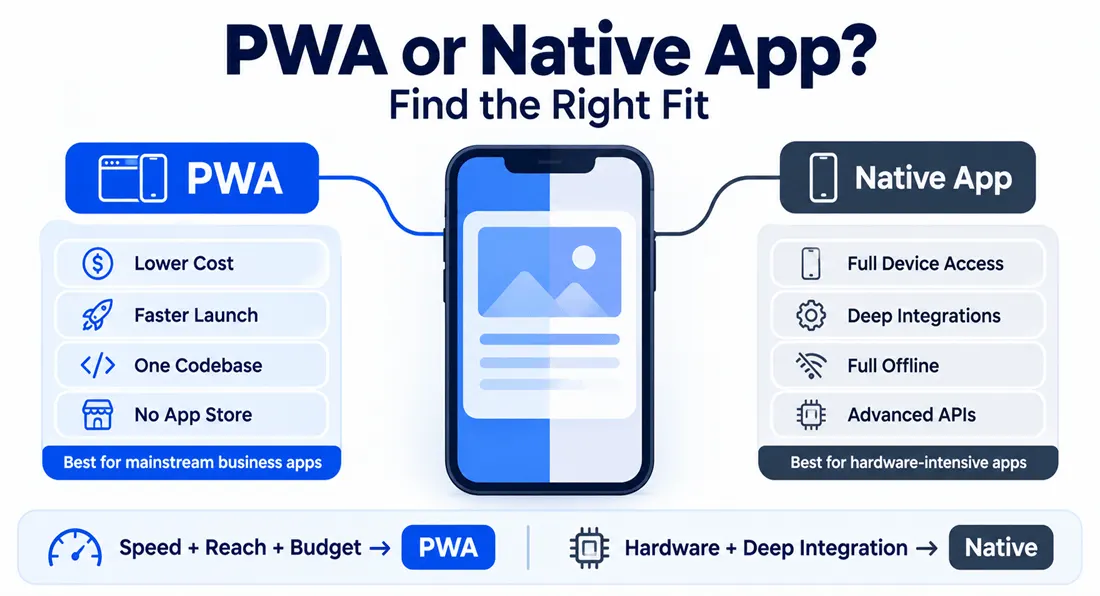
Budget, timeline, and the level of app integration with device hardware are the main factors driving the choice between PWA vs mobile app. Responsive Web Apps are already meeting user expectations for most common business applications, and native apps can still outperform them in camera-intensive or sensor-focused or offline-first products such as fitness trackers or AR applications.
| Factor | PWA | Native App |
| Development cost | Lower | Higher |
| Install required | No | Yes |
| App store approval | No | Yes |
| Offline support | Partial | Full |
| Device API access | Limited | Full |
When a Custom PWA Development Approach Makes Sense
When your company requires complex flows, integrations with existing systems, like CRM or payment, and a strong brand, custom PWA development is the correct choice. Business PWA development agencies like Meta App Designs can create them from the ground up to meet the performance standards of native competitors.
The same goes for the future-proof of the product, as a well-architected PWA can be incrementally developed and doesn’t require a full rebuild down the road.
Signs Your Business Needs a PWA
Not all businesses have to transition now, but there are some indications that the time is right. One of the best indicators is the fact that mobile web activity is virtually inseparable from e-commerce activity, as close to 60 percent of all mobile web traffic is now dedicated to e-commerce, according to a recent report from SNS Insider on GlobeNewswire.
Here are some indicators that it’s time to consider a PWA:
- High mobile traffic but low conversion rates
- Users abandoning slow-loading pages
- Budget constraints for building two native apps
- A need for offline access to key content or services
Conclusion
PWAs won’t be a fad; they will continue to be a viable option between websites and native apps, resolving real business problems along the way. Whether the goal is faster load times, lower development costs, or simply reaching users without an app store gatekeeper, progressive web app development remains one of the smartest investments a business can make in 2026.