For apps to flourish instantly after launch and sustain scalability, however, are two entirely different stories. Converging these two distinct approaches needs smart adoption of backend technologies. Every viral app can face the same fate – not necessarily due to bad design, but because its backend buckles under genuine traffic.
Thank you for reading this post, don't forget to subscribe!A scalable app backend should not be a technical afterthought in the current digital age; it should be a smart strategic decision. At Meta App Designs, the right backend development opportunities can convert early traction into enduring growth.
Five Core Factors Driving a Sustainable Scalable App Backend
Table Of Content
Scalability is not a product of a single smart hack – in fact, it is a phenomenon achieved through a well-orchestrated integrated eco-system driven by following factors:
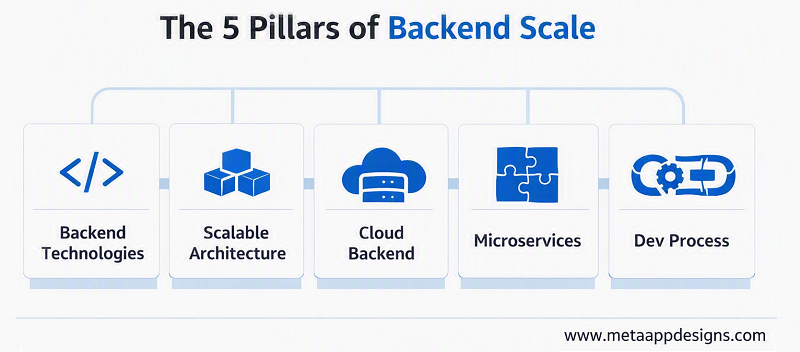
1. Backend Technologies
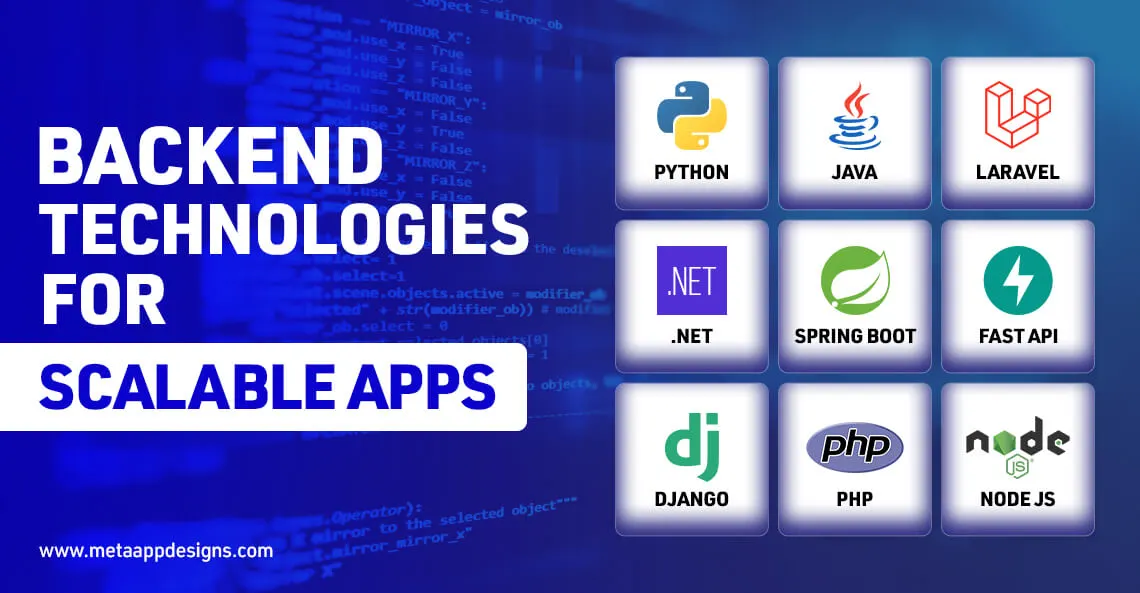
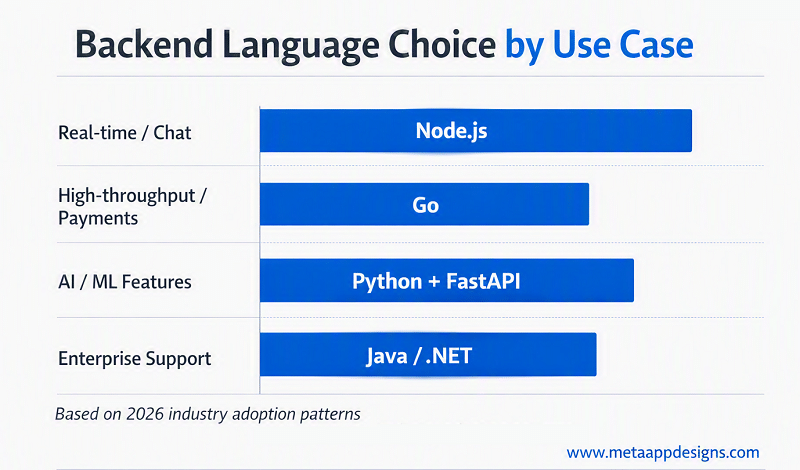
Node.js backend systems are still relevant and lead for real-time apps due to their event loop; Go wins high-throughput payments work; Python with FastAPI now dominates AI-driven features. This decision determines hiring speed and performance ceiling alike.
2. Scalable App Architecture
A monolith is okay for an MVP, but growth would require distributed systems – this is where microservices architecture enables you to scale chat independently from payments.
3. Cloud backend infrastructure
AWS, Google Cloud, and Azure now make auto-scaling, managed databases, and global CDNs table stakes for any serious scalable app backend.
4. Microservices architecture in practice
Distributing an app into small, independent services means one team can ship without disrupting another’s work, though it involves real investment in observability tools like Datadog and a service mesh like Istio.
5. Backend development process
If the process is weak, even the strong tech would fail. Teams now ship daily using OpenAPI specs, GitHub Actions CI/CD, Docker, and Kubernetes – developer experience has turned into its own KPI.
When these factors work in coordination, backend decision-making become the corner stone for stable, scalable, and sustainable long-term app progress.
How Global Platforms Scale Backend Requirements
This is no longer a theory now – it’s actually a practical display of performance by platforms, proving how their operations are carrying the majority of traffic.
Netflix now serves more than 325 million subscribers worldwide on an AWS-hosted microservices architecture developed from over 1,000 independent services; if recommendations go down, playback keeps functioning, because Node.js and Java manage the APIs behind each operation individually.
Uber inclines towards Go’s concurrency model across its real-time systems – its engineering team once halved ingestion latency on its M3 observability platform by re-architecting around how the Go compiler handles memory, proof that choice of language holds real operational weight at scale.
Shopify operates its commerce infrastructure on a cloud backend based on Google Cloud, and it exhibited during the 2025 Black Friday–Cyber Monday weekend: merchants generated $14.6 billion in revenue, a 27% rise year-over-year, while the platform processed a peak of 489 million requests per minute at the edge without crumbling.
Duolingo’s serverless AWS system once absorbed 4 million push notifications within six seconds during a single Super Bowl ad break – the kind of burst a fixed server fleet would never have handled cheaply.
On similar grounds already set by industry giants, Meta App Designs has built a Naperville logistics client’s core on a Node.js backend and microservices architecture adopted on AWS.
Through Black Friday, the app handled 5 times additional, more than normal traffic with zero downtime, and orders were processed 37% faster after Redis caching and async queues were added from day one. This proves that Meta App Designs backend development follows the same principles successfully, but at a very different scale.
How to Choose Backend Technologies for Your App
You don’t have to replicate Netflix’s stack on your launch day – you should follow the thought process behind their decision-making.
Begin by determining anticipated traffic: spiky demand calls for a cloud backend with auto-scaling, whereas, real-time chat or live tracking points straight to a Node.js backend.
Then select the architecture – a modular monolith works faster for one or two developers, while microservices architecture allows multiple teams to ship without disrupting each other’s work, keeping in mind that observability is budgeted in from day one. Talent and use cases are as significant as raw performance standards.
A small team developing rapidly with a broad library ecosystem often opt for Node.js; a team following sub-millisecond throughput for payments would pick Go; while a product built around AI features would generally choose Python.
The table below displays the shortcut version of this decision paradox:
| Use Case | Recommended Technology | Why It Fits |
| Real-time chat / live tracking | Node.js backend | Event-driven, handles concurrent connections efficiently |
| High-throughput payments | Go | Built-in concurrency, low memory overhead |
| AI / ML features | Python + FastAPI | Native ML ecosystem, strong async support |
| Enterprise integrations | Java / .NET | Mature tooling, long-term enterprise support |
Whichever technology you select, bake in scale early: add Redis for caching, index the database properly, and use a message queue such as RabbitMQ for background tasks. These are the same behind the scene choices that separate a scalable app backend from one held together by luck.
This is the exact blueprint behind every Meta App Designs scalable mobile apps engagement – not the most complex stack available, but the one that helps a product on marketing front, and provides it with support to sustain plus scale once actual users arrive.
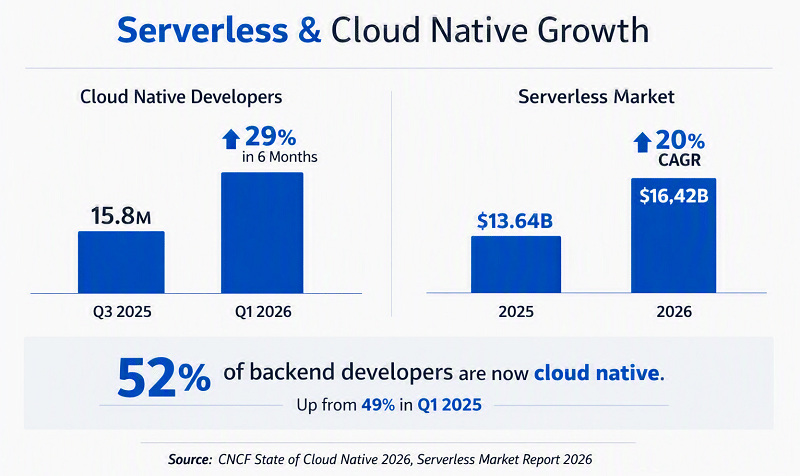
Backend teams that invest in this thought process early consistently prevent the costly rewrites that make the growth stagnant later, a pattern reflected across the serverless computing market, now projected to exceed $61 billion in 2026 as more businesses choose to pay only for what they use.
Backend Technologies Build the Scalable App
A refined UI help gain downloads, while a credible scalable app backend retains the high value users.
These days, growth comes down to smart picks in backend development, architecture, and cloud. From Node.js backend to microservices architecture, the right foundation allows a product to grow with stability without succumbing to any pressure. Meta App Designs’ primary focus is to builds that foundation first.