Gamification in educational apps is no longer a trend but a core part of the teaching environment, transforming how students access education on their smartphones and tablets. Learners now earn points and unlock levels as they learn new concepts, and they compete against other learners on leaderboards rather than through static text and quizzes.
Thank you for reading this post, don't forget to subscribe!This change is one of the best ways to increase the number of young users returning to a developer’s site every day, and for schools, it’s an excellent way to keep young users from leaving.
Why Gamification Works in Learning
Table Of Content
Reward loops capture the human brain’s attention, and well-designed gamified learning apps resonate. A dopamine response when a student completes a module, plus a progress bar or badge moving toward completion, creates a feedback loop that keeps them coming back.
If a student completes a module and gets a dopamine response (i.e., a badge or progress bar moving toward completion), it creates a feedback loop the student will want to repeat. This pattern holds users’ attention much longer than something without multimedia components.
A recent systematic review of school engagement research found that gamified strategies were regularly effective in increasing student engagement in the learning process, partly because of the feedback and progress tracking provided in the activities (Frontiers in Education).
This is particularly true of eLearning app development, where maintaining engagement in distance and on-demand learning is always challenging.
Core Gamification Strategies for Educational Apps
Not all game mechanics suit all apps. The best gamification strategies are selected on the basis of content, age, and duration of the session and NOT applied as a one-size-fits-all solution.
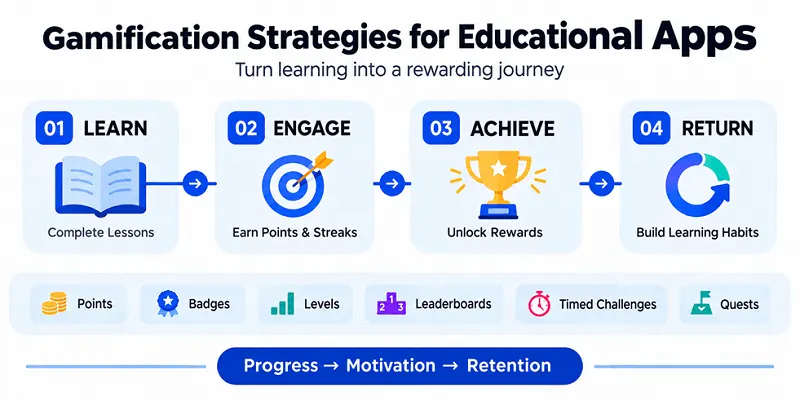
Developers building student engagement apps typically begin with a few small concepts that are familiar to developers and are proven to be rewarding for students, before adding more. Top Apps have a number of elements that they share, such as:
- Daily streaks that reward consistent logins
- Leaderboards for friendly peer competition
- Unlockable avatars or themes as rewards
- Timed challenges that build quick recall
- Narrative-driven quests tied directly to lesson content
Points, Badges, and Levels
It’s the three mechanics that most mobile learning platforms rely on. Points provide feedback on consistency, badges signify achievement of milestones and levels provide a way for learners to see some forward progress in their course work.
All of these features create a skill journey that is not a theory that can only be learned in a classroom, but something that can be achieved and experienced. It’s this visibility that can make a difference between an app that students forget to use and one that they use every day without missing.
Measuring the Impact of Gamified Design
There is a reason why numbers are important in schools and parents’ decisions as to the adoption of an app for the long run. Considerable positive effects of gamification on learning outcomes on the overall level were revealed in a large-scale meta-analysis of more than 5,000+ participants in 49 independent studies NCBI meta-analysis.
As the comparison below illustrates, there are generally differences between the traditional form and the gamified form of a class app:
| Feature | Traditional App | Gamifed App |
| Daily return rate | Low to moderate | High |
| Content completion | Often partial | Higher completion |
| Emotional engagement | Neutral | Positive, reward-driven |
| Long-term retention | Variable | Strengthened by repetition |
Where Education Technology Apps Are Headed
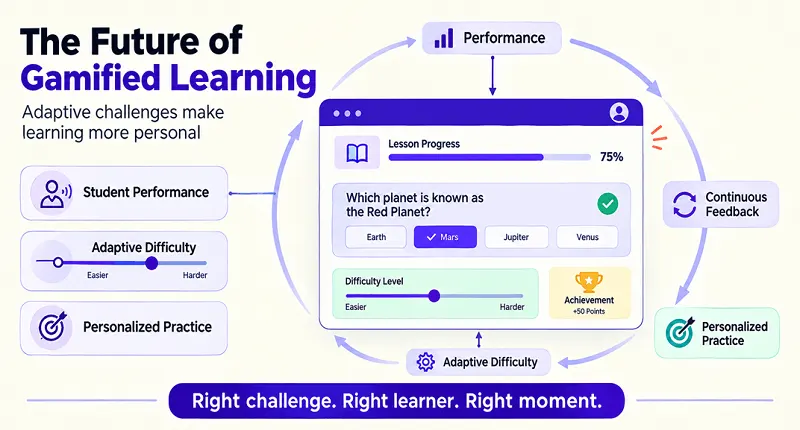
The phrase interactive learning with adaptive difficulty is becoming commonplace in education technology apps, that is, rapidly changing difficulty levels based on performance. This prevents advanced students from becoming bored and disheartens the more challenging learners.
Conclusion
Gamification is no longer a new concept to be added to learning apps, it’s being expected. Whether it’s points, streaks, or adaptive challenges, these features transform screen time into meaningful and engaging practice. Firms specializing in educational app development, including teams like Meta App Designs, now pair gamification with analytics to refine features long after launch.
As gamification in educational apps continues to mature, schools and developers who invest early in thoughtful, data-informed design will likely see the strongest gains in engagement and outcomes.